




In a striking display of military readiness and aerial defense strategy, U.S. and Canadian forces recently scrambled fighter jets to intercept and escort a formation of Russian military aircraft near the Alaskan airspace. This incident highlights growing air activity in the Arctic region and the strategic importance of monitoring world powers’ long-range aviation operations.
What Happened?
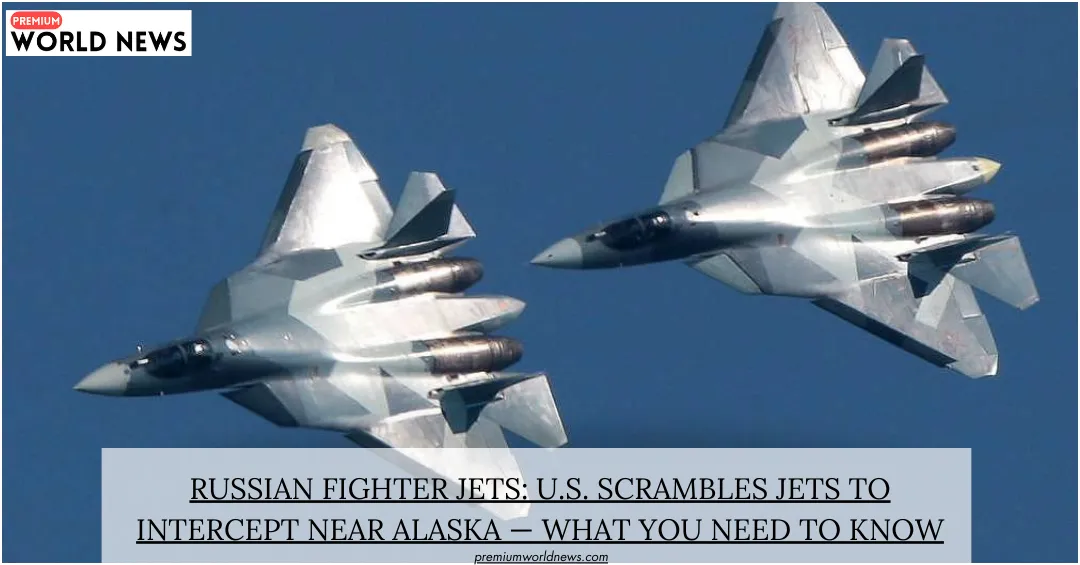
On February 19, 2026, the North American Aerospace Defense Command (NORAD) detected five Russian aircraft — including long-range Tu-95 strategic bombers, Su-35 fighter jets, and an A-50 airborne early warning aircraft — flying within the Alaska Air Defense Identification Zone (ADIZ).
In response, NORAD launched:
- Two U.S. F-16 Fighting Falcons
- Two F-35 Lightning II fighters
- One E-3 Sentry AWACS aircraft
- Four KC-135 refueling tankers
These aircraft intercepted, positively identified, and escorted the Russian formation until it exited the ADIZ.
Why It Matters
Although the Russian planes remained in international airspace and never entered sovereign U.S. or Canadian territory, these events are significant for several reasons:
- ADIZ Protocols and National Security
- The ADIZ begins where a nation’s sovereign airspace ends and is designed to allow defense forces to identify incoming aircraft for security purposes.
- Operating inside an ADIZ requires identification and tracking, even if the aircraft remain in international airspace.
- Persistent Air Patrol Activities
NORAD officials noted that Russian activity in the Alaska ADIZ is regular and not currently viewed as a direct threat — but it does serve as a key monitoring point for strategic aerial operations near North America.
These operations have occurred repeatedly in recent years, with similar intercepts in 2024 and 2025. Each event underscores the continued importance of aerial vigilance and joint defense cooperation between the U.S. and Canada.
The Strategic Angle: Arctic and Global Power Projection
The Arctic region has become increasingly important for global security and military operations. Russia regularly conducts long-range training flights over the Bering Sea, Arctic Ocean, and North Pacific, often involving bombers and fighters. These missions help Moscow demonstrate airpower reach and test response times from Western defense forces.
For the United States and Canada, such activity reinforces the need for state-of-the-art fighter jets like the F-35 and F-16 — capable of rapid response, aerial identification, and effective escort missions.
Key Takeaways
- Russian military aircraft were intercepted in the Alaska Air Defense Identification Zone on February 19, 2026.
- U.S. and Canadian fighter jets escorted the Russian formation until it exited the zone.
- The incident was routine and did not present a direct threat to sovereign airspace.
- Such encounters emphasize the importance of aerial defense readiness and international monitoring of military flight operations.